
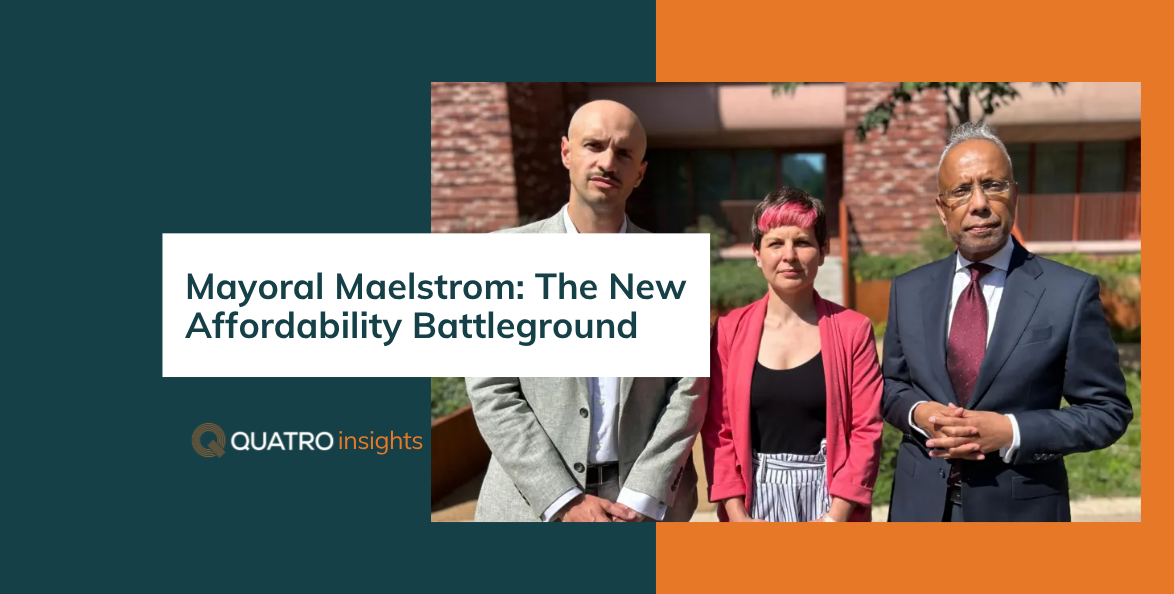
Mayoral Maelstrom: The New Affordability Battleground
26 June 2026 | Pearce Branigan
This week, the mayors of Hackney, Lewisham and Tower Hamlets called for a judicial review against the Mayor of London, over the plans to lower the London-wide GLA affordability threshold to 20 per cent.
The three London Boroughs launched a joint legal challenge to the High Court on Wednesday 24 June, on the basis that the Mayor of London did not use the proper statutory process – or consult councils – before the policy change was made.
The three mayors have indicated that the move has been prompted by the alleged detrimental impact the policy change would have on their ability to deliver the highest levels of affordable housing in their boroughs.
How did we get here?
In October 2025, the Mayor of London and the Government unveiled a package of emergency measures to provide ‘targeted, time-limited support’ to improve the viability of residential schemes and get quicker approvals across Greater London.
These measures were confirmed in March 2026 and supplemented with additional powers for the mayor to call in sites, being fronted by a commitment to boost viability by reducing the affordability threshold for sites across London from 35 to 20 per cent.
This announcement was criticised by several Labour London council leaders ahead of the local elections in May, who felt that the move undermined their higher borough-wide thresholds – of up to 50 per cent in areas – which had been pursued independently for several municipal terms.
The reaction from City Hall
City Hall has stated that these measures were introduced to help speed up planning decisions, incentivise developers and build more homes for Londoners – with figures for 2024/25 showing that just 3,991 affordable homes were built across the capital. Responding the legal challenge, Sir Sadiq stood by the policy move, noting that “we need to have more homes in London – more genuinely affordable homes.”
This is not the first time that the Mayor of London has had to battle legal challenges – having successfully contested a challenge against his ULEZ campaign in his second term in 2023. It is likely that this latest challenge will prove equally unsuccessful.
However, the political repercussions of the policy going ahead – regardless of any improvement in the number of affordable homes delivered in the short term – may prove disastrous for Sir Sadiq and London Labour in the longer term.
Green shoots of ambition or higher aspirations?
The policy motivation for those council’s backing the legal challenge is clear.
For Lutfur Rahman in Tower Hamlets, his previous tenure saw the delivery of 6,441 affordable homes. In May, his Aspire Party was returned to power with an increased majority, on a manifesto to deliver 12,000 affordable homes across two terms. Though Rahman identifies the place of the borough’s 40 per cent affordable threshold as having been integral to achieving this, arguably the biggest factor in delivering affordable homes in Tower Hamlets has been the designation of large parts of the borough as tall building zones, allowing for massing not readily encouraged in other areas of London.
For the Green administrations in Hackney and Lewisham, as well as those in Lambeth, Haringey, Southwark and Waltham Forest – who all supported the legal challenge – all were elected on manifestos that exclusively focused on the delivery of affordable and council-backed social homes. For Zoë Garbett in Hackney, her mayoral manifesto went so far as to commit to using the council’s pension funds to purchase or buy-back council homes.
All Green-led London Boroughs contest the current definition of affordable housing, particularly shared ownership. The consistent position is that social rent (i.e. at roughly 40–50 per cent of market rate) is the only genuinely affordable tenure, and that any development falling short of this is inadequate. Following the launch of the legal challenge, Green administrations across London are likely to refuse any and all future policy-compliant schemes at 20 per cent affordable threshold on a point of principle, holding out for their own preferred threshold of over 50 per cent.
The broader context of this move by the new Green administrations across London – and the association of Aspire in Tower Hamlets – is significant, as it goes beyond the mere policy issue of alleviating council housing waiting lists: It goes to the heart of both parties ambitions to replace Labour as the dominant political hegemon.
While Rahman has cemented himself successfully as the sole political force of relevance in Tower Hamlets, for the Green Party, this judicial review – regardless of the outcome – has bigger implications. This legal challenge has marked the unofficial starting gun on the Green Party’s campaign to challenge Labour for the London Mayoralty in 2028.